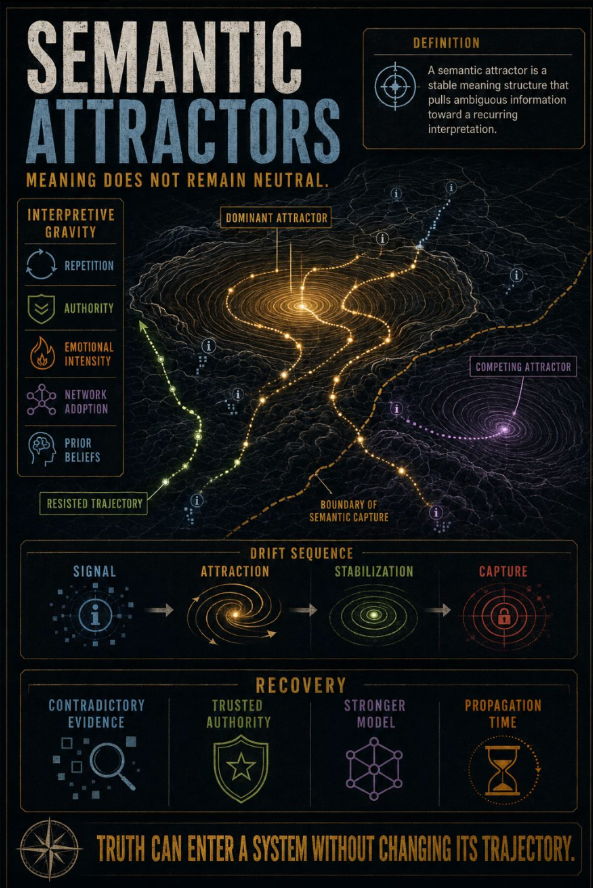
Definition
Canonical Text
Meaning does not remain neutral.
Organizations do not interpret every event from a neutral position. They develop semantic attractors: stable configurations of meaning toward which new information is repeatedly drawn.
An attractor may be a mission, doctrine, threat model, institutional identity, or shared explanation of how the world works. Once established, it organizes interpretation around itself.
The same event can therefore produce different responses.
A delayed deployment may be interpreted as prudent verification in a safety-oriented system, bureaucratic obstruction in a speed-oriented system, or evidence of disloyalty in a system organized around internal threat. The event has not changed. The attractor has changed what the event can mean.
This creates interpretive gravity: the force by which an established meaning structure pulls ambiguous signals toward itself.
A meaning repeatedly expressed by trusted authorities, distributed across the organization, emotionally reinforced, and connected to existing beliefs develops greater semantic mass. As that mass increases, alternative interpretations require more energy to remain viable.
This is why organizations can drift without formally changing doctrine. New information is absorbed into the dominant attractor until the organization’s interpretation of reality separates from reality itself.
Contradictory evidence may not correct the system. It may be reclassified as noise, incompetence, hostility, or further proof that the existing interpretation is correct.
Semantic stability has then become semantic capture.
Recovery requires more than presenting better information. A corrective signal must generate enough interpretive force to escape the existing attractor basin.
That may require evidence that cannot be assimilated into the prevailing explanation, a trusted authority capable of legitimizing reinterpretation, a competing model with greater explanatory power, and enough time for the new meaning to propagate.
Without those conditions, truth may enter the organization without changing its trajectory.
Command therefore depends not only on what information reaches the system, but on the semantic field into which that information arrives.
Meaning moves.
Meaning accumulates mass.
Meaning bends interpretation around itself.
When an organization can no longer distinguish semantic stability from semantic capture, it may remain perfectly coordinated around a reality that no longer exists.
Candidate Formalization
Interpretive gravity.
The strength of a semantic attractor can be represented as a candidate functional relationship:
This expression is not yet a validated quantitative law. It identifies candidate variables that may contribute to the strength of interpretive attraction and provides a structure for future operationalization.
System Mechanism
How semantic capture forms.
Mission, doctrine, threat, identity, or explanation begins organizing what the system notices and expects.
Repetition, authority, emotional intensity, network adoption, and prior belief make the interpretation easier to reproduce.
New events arrive without a single self-evident meaning and must be interpreted through the existing semantic structure.
The event is pulled toward the explanation the system is already prepared to recognize.
Evidence that should destabilize the model may instead be classified as noise, hostility, incompetence, or proof of the model itself.
Coordination remains strong, but the shared interpretation loses contact with changing conditions.
Failure Signatures
What an observer would see.
Disconfirming signals are absorbed rather than allowed to change the model.
Different attractor fields generate different action from identical information.
Formal language is preserved even as its operational meaning changes.
More evidence, authority, and time are required for a competing model to remain viable.
The organization remains aligned because everyone is organized around the same obsolete meaning.
The system defends semantic stability at the expense of adaptation.
Recovery Conditions
What can escape the attractor basin.
The corrective signal must resist reinterpretation as noise or confirmation.
Evidence alone may not move a system unless reinterpretation is institutionally permitted.
The system needs an alternative structure capable of organizing the evidence better.
New meaning must spread through the network before the system crosses an irreversible boundary.
Publication Record
Canonical and distributed versions.
- Canonical URL
- meaningintegrity.com/publications/semantic-attractors.html
- Author
- Caroline Suzanne Brooks
- Published
- August 1, 2026
- Publication type
- Research Note and Framework Introduction
- Research program
- Physics of Command
- Original platform
- LinkedIn publication
- Visual model
- Semantic Attractors, created for this publication
- Research status
- Developing framework with candidate variables identified for future operationalization